

- Home
- Products
- Road Safety Barriers
- RamShield Low Deflection
RamShield® Low Deflection Guardrail Barrier
Reducing the Distance Required to Shield Roadside Hazards
RamShield® Low Deflection Guardrail Barrier
Reducing the Offset between Barrier and Hazard

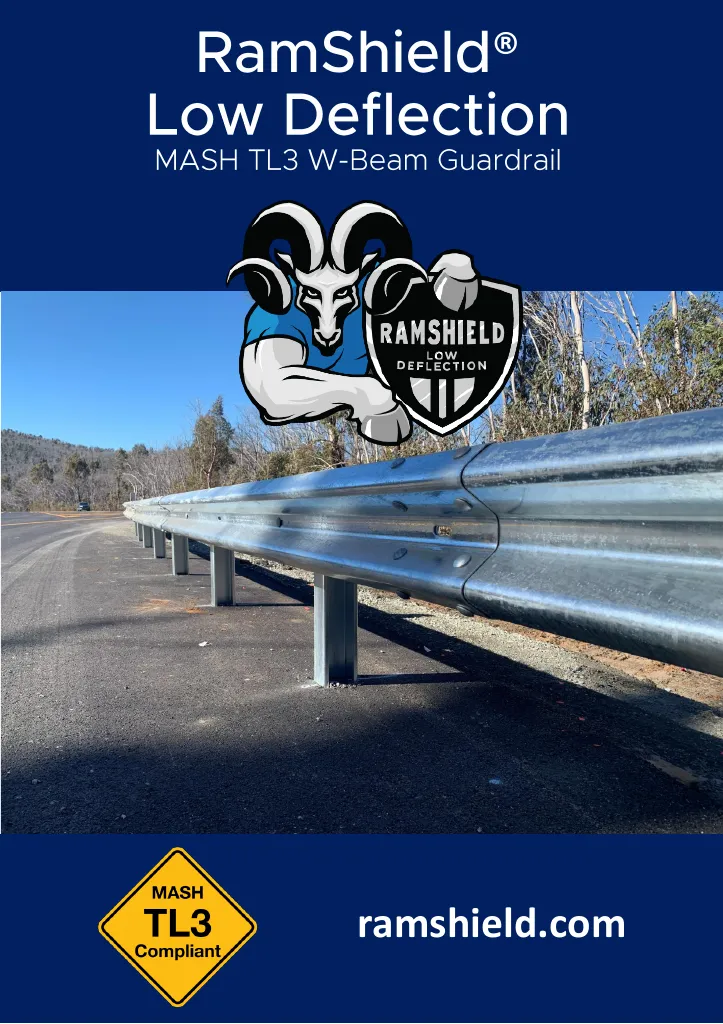
RamShield® Low Deflection is a stiffer w-beam guardrail variant designed to reduce the amount of clearance required between the barrier and roadside hazard. RamShield® Low Deflection has been full-scale crash tested in accordance with Test Level (TL) 3 of the Manual for Assessing Safety Hardware (MASH), and is recommended for acceptance by the Austroads Safety Barrier Assessment Panel (ASBAP) and approved for use by Australian state road agencies.
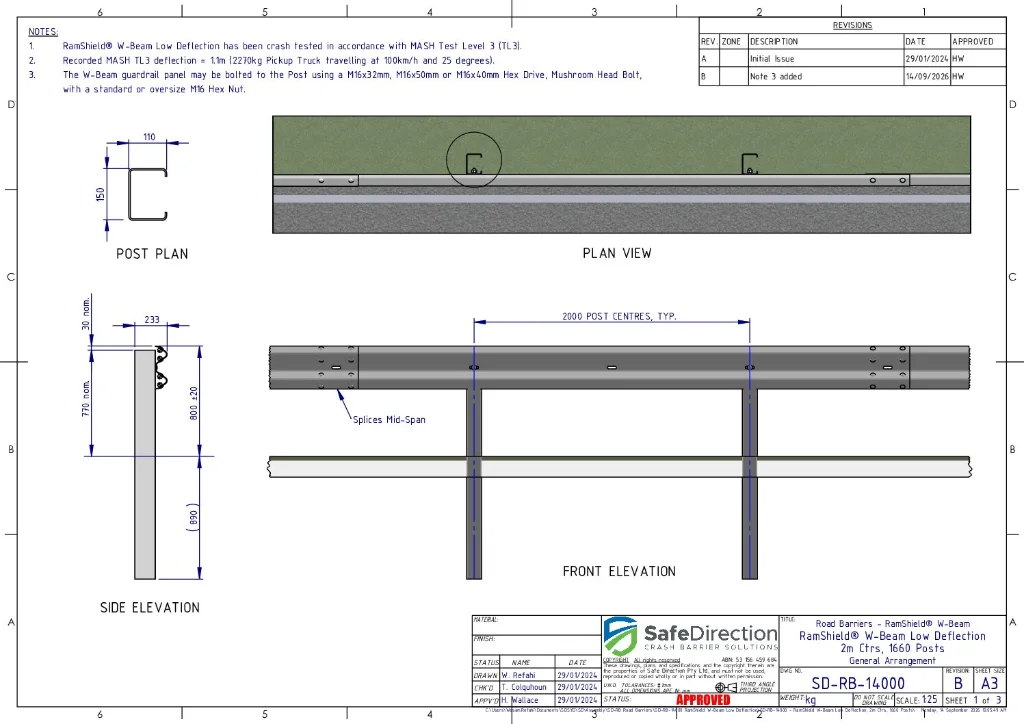
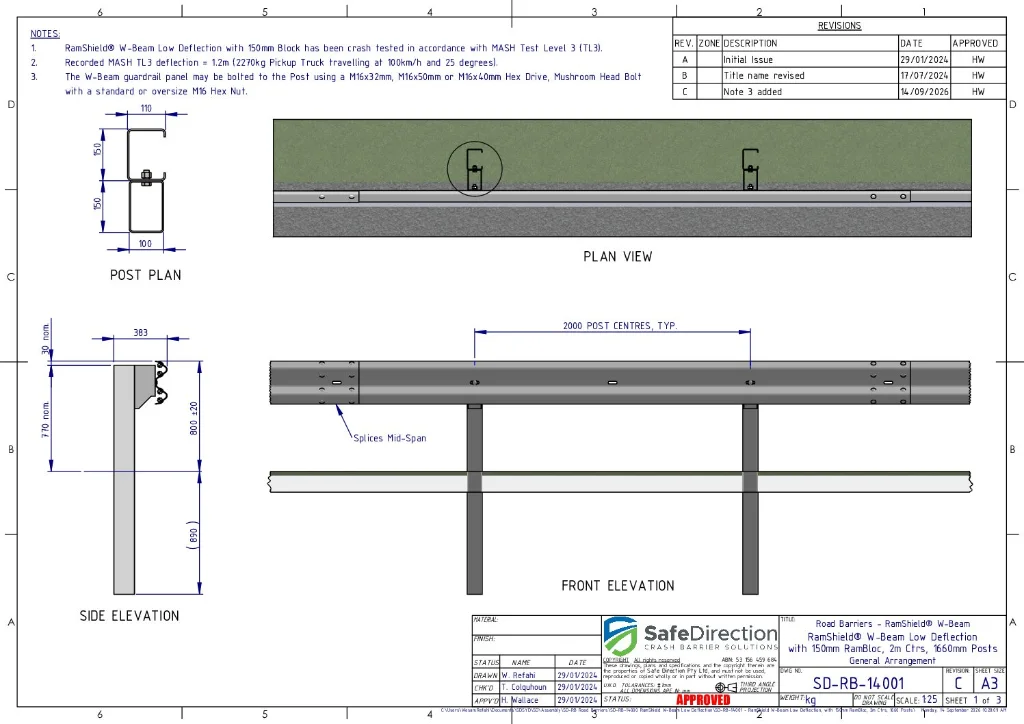
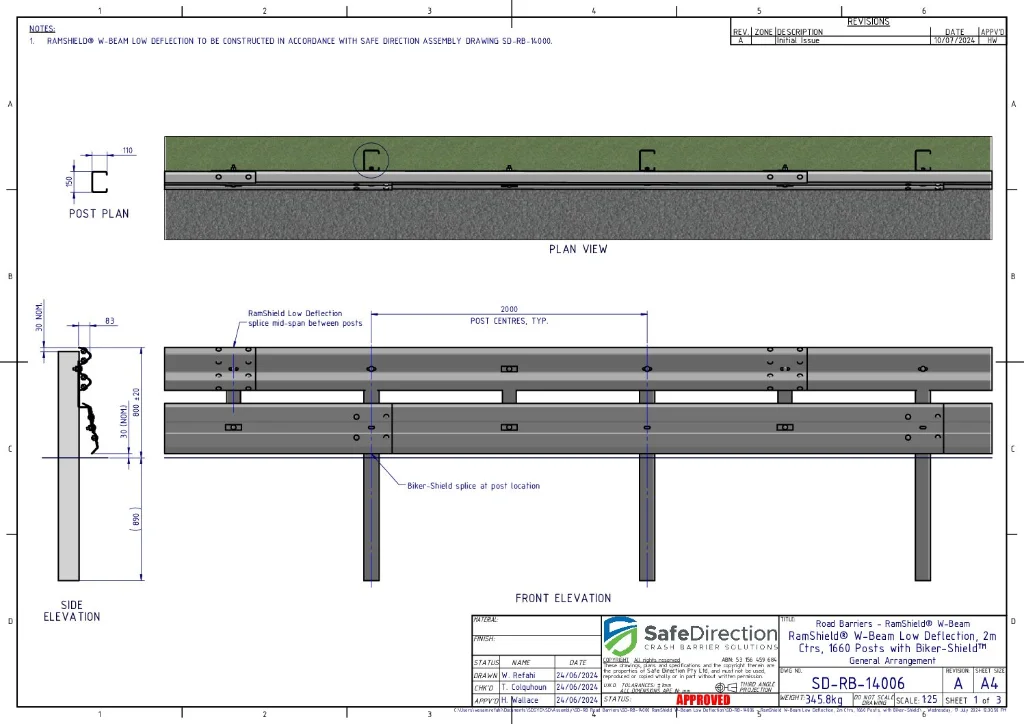
RamShield® Low Deflection features heavy duty C-posts increasing the lateral strength of the system and reducing dynamic deflection. RamShield® Low Deflection is available as two (2) configurations. The w-beam guardrails may be bolted directly to the C-posts providing a narrow system width of just 235 mm. Alternatively, a spacer block, known as the RamBloc®, can be positioned between the C-post and w-beam guardrail providing an offset of up to 300 mm. The use of an offset may be desirable to avoid conflict with underground services or prevent nuisance impacts with the C-posts.
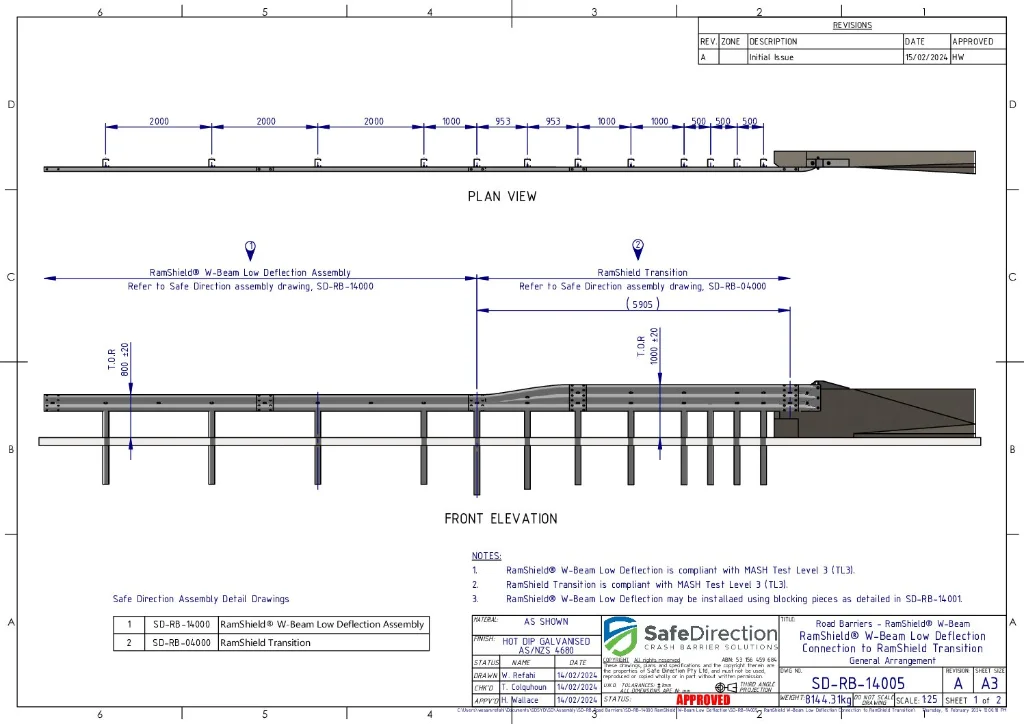
RamShield® Low Deflection may be connected directly to RamShield® W-Beam, RamShield® High Containment or the RamShield® Transition.
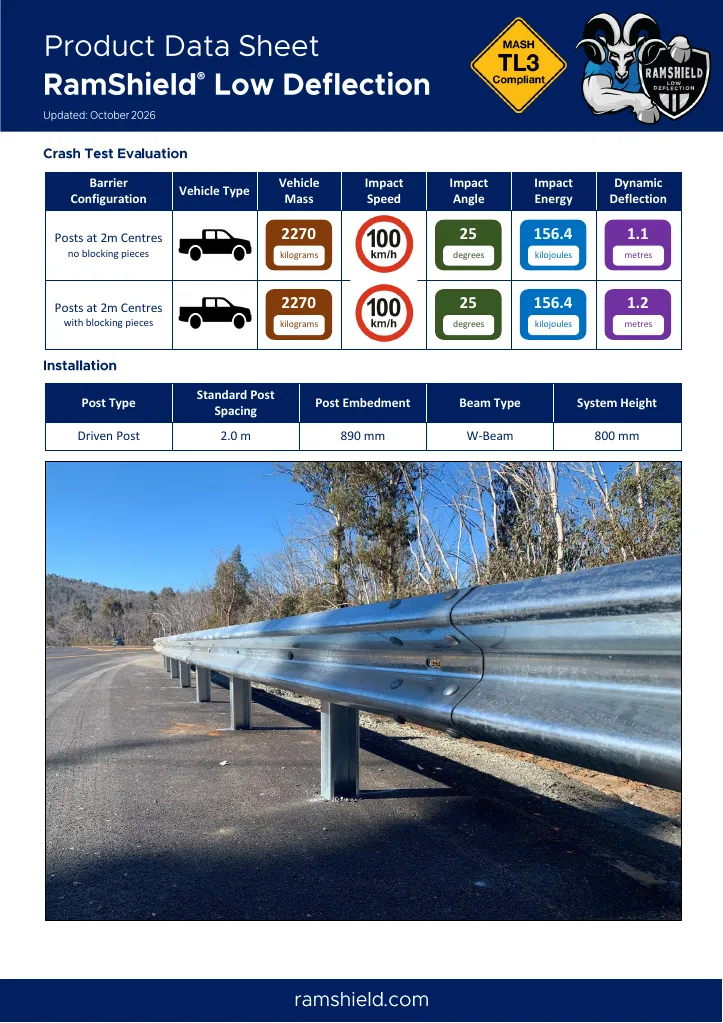
Crash Test Evaluation
Barrier configuration |
Vehicle |
Mass |
Impact Speed |
Impact Angle |
Impact Energy |
Dynamic Deflection |
|---|---|---|---|---|---|---|
Posts at 2 m centresno blocking pieces |
2,270kilograms |
100km/h |
25degrees |
156.4kilojoules |
1.1metres |
|
Posts at 2 m centreswith blocking pieces |
2,270kilograms |
100km/h |
25degrees |
156.4kilojoules |
1.2metres |
Installation
Post type |
Standard post spacing |
Post embedment |
Beam type |
System height |
|---|---|---|---|---|
| Driven post | 2.0 m | 890 mm | W-beam | 800 mm |
Key Features
- MASH TL3 compliant
- Evaluated with and without blocking pieces (RamBlocs®)
- MASH TL3 deflection without blocks: 1.1 m
- MASH TL3 deflection with RamBlocs®: 1.2 m
- W-beam rail height: 800 mm
- Standard post spacing: 2 m centres
- Recommended for acceptance by ASBAP
Video
Frequently Asked Questions
How does RamShield® Low Deflection work?
Stable vehicle containment is achieved by regulating the force required to release the w-beam guardrail during a vehicle collision. The C-posts provide lateral support to the system limiting dynamic deflection, before yielding by bending proximate to ground level as they are contacted by the errant vehicle.
What is dynamic deflection?
Dynamic deflection is the maximum displacement of the barrier recorded during full-scale crash testing. The dynamic deflection result is the recommended clearance between the barrier, measured from the face of the w-beam guardrail, to the roadside hazard.
When would I specify RamShield® Low Deflection?
RamShield® Low Deflection is the preferred guardrail barrier solution where the distance between the proposed location of the barrier and roadside hazard is limited.
Alternatively, RamShield® Low Deflection is the only MASH compliant w-beam guardrail system available within Australia that can be configured with an offset block. An offset of up to 300 mm is available allowing the alignment of the C-posts to be set back from the face of the w-beam guardrail, avoiding underground obstructions and/or preventing nuisance impacts with the C-posts.
What is the containment level of RamShield® Low Deflection?
Both variants of RamShield® Low Deflection, with and without offset blocks, have been crash tested in accordance with MASH Test Level 3, demonstrating safe containment of a 2270 kg pick-up truck travelling at 100 km/h and 25 degrees.
What configuration variants are available?
RamShield® Low Deflection may be installed with the w-beam guardrail bolted directly to the C-posts providing a narrow width system. Alternatively, offset blocks known as RamBlocs®, may be positioned between the w-beam guardrail and C-posts.
What is the advantage of installing RamBlocs®?
The development of RamBlocs® followed feedback from road designers who preferred an offset between the face of the w-beam guardrail and the alignment of the C-posts. An offset avoids conflict with underground services and reduces the potential for nuisance impacts with the C-posts.
What is the standard width of a RamBloc®?
The standard width of the RamBloc® is 150 mm, manufactured from a rectangular hollow section (RHS). The use of RHS increases torsional strength preventing deformation during a vehicle collision.
Can RamBlocs® be supplied in other widths?
Yes. The RamBloc® is available in widths of 200 mm, 250 mm and 300 mm. The wider blocking pieces do not influence the stable redirection of the 2270P or change the barrier dynamic deflection.
How are the C-posts installed?
The C-posts are driven directly into the ground using a vibrating hammer to a depth of 890 mm. The installation of the C-posts does not require concrete.
Can the spacing of the C-posts be reduced to lower dynamic deflection?
Yes. At constrained sites where the clearance between the barrier and hazard cannot accommodate the dynamic deflection at 2.0 m post spacing, the post spacing may be reduced to 1.0 m centres.
Can the C-posts be installed on a concrete strip footing?
Yes. At constrained sites where underground obstructions prevent the installation of driven posts, a concrete strip footing may be constructed and posts with baseplates installed.
Can RamShield® Low Deflection be configured with motorcycle protection barrier?
Yes. Both variants of RamShield® Low Deflection may be installed with BikerShield which shields the C-posts from a sliding, dismounted rider. BikerShield features lightweight panels which do not affect the safe containment and redirection of errant vehicles.
What is MASH?
The Manual for Assessing Safety Hardware (MASH) provides uniform guidelines for the crash test assessment of permanent and temporary roadside hardware.