

- Home
- Products
- Road Safety Barriers
- RocketBloc
RocketBloc® Retrofit Blocking Piece
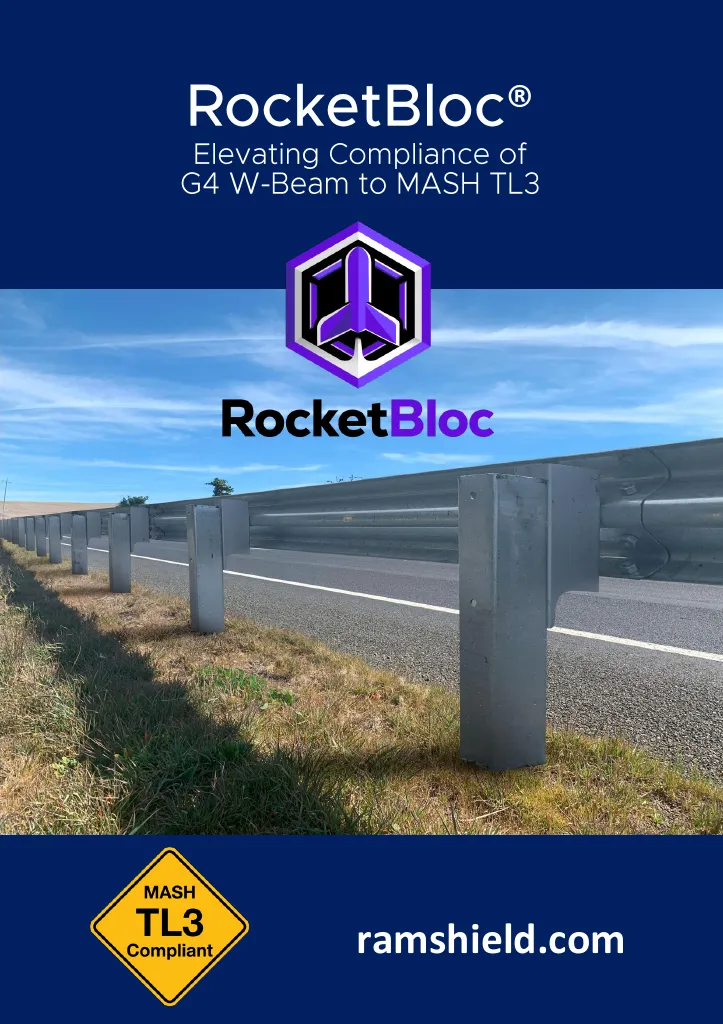
Elevating G4 W-Beam Guardrail to MASH Test Level 3
RocketBloc®
Elevating G4 W-Beam Guardrail to MASH Test Level 3

RocketBloc® is a steel blocking piece designed to replace the existing C-blocking piece of G4 W-Beam Guardrail installations. Following the Australian implementation of MASH, G4 W-Beam Guardrail has been reclassified Legacy status, failing to meet MASH requirements. The retrofitting of RocketBloc® elevates compliance of G4 W-Beam Guardrail to MASH TL3, extending the service life of existing barrier installations and providing compliance with current standards.
RocketBloc® is recommended for acceptance by the Austroads Safety Barrier Assessment Panel (ASBAP) and approved for use by Australian state road agencies.
The attachment of RocketBloc® does not require dismantling of the existing G4 W-Beam Guardrail and can be undertaken using hand tools.
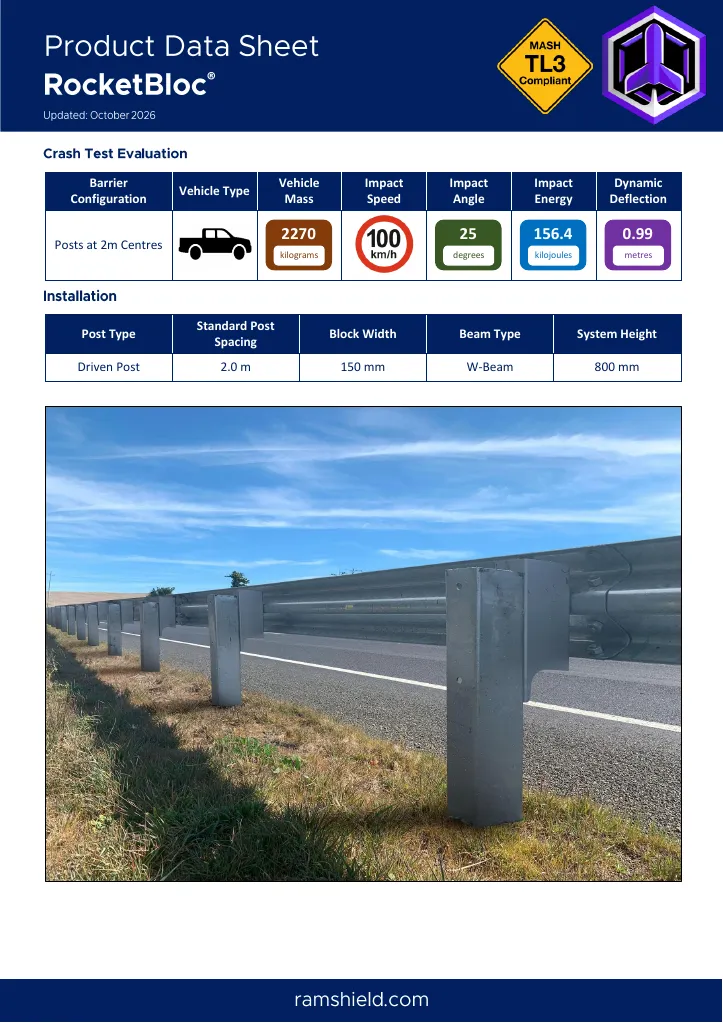
Crash Test Evaluation
Barrier Configuration |
Vehicle |
Mass |
Impact Speed |
Impact Angle |
Impact Energy |
Dynamic Deflection |
|---|---|---|---|---|---|---|
Posts at 2 m centres |
2,270kilograms |
100km/h |
25degrees |
156.4kilojoules |
0.99metres |
Installation
Post type |
Standard Post Spacing |
Block Width |
Beam Type |
System Height |
|---|---|---|---|---|
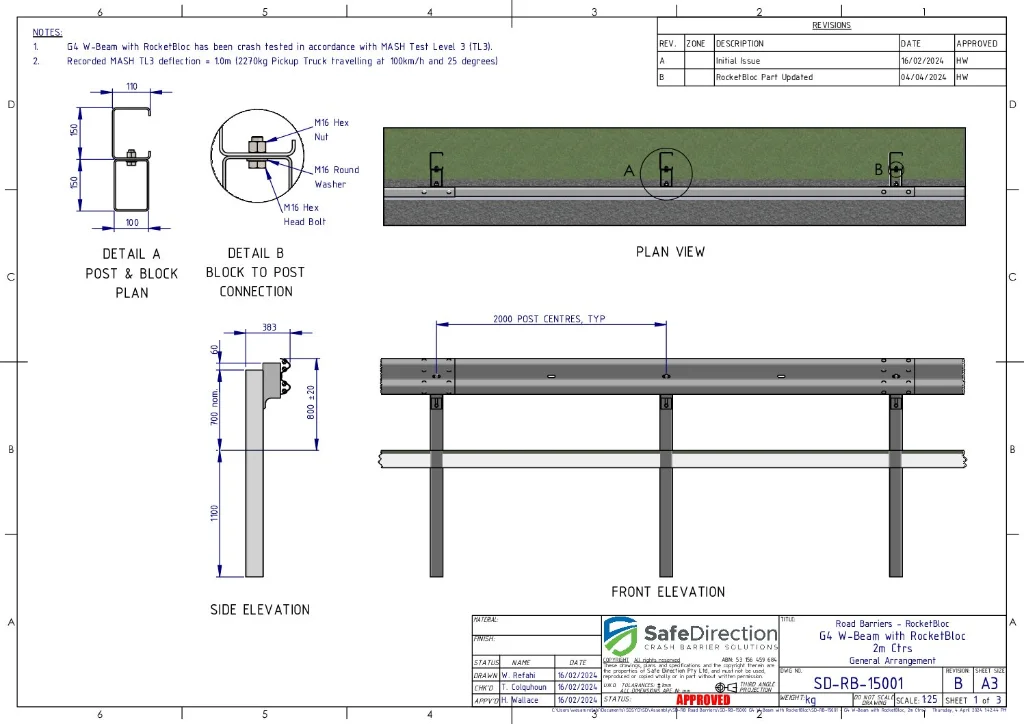
| Public domain C-post | 2.0 m | 150 mm | W-beam | 800 mm |
Key Features
- MASH TL3 compliant
- MASH TL3 dynamic deflection: 0.99 m
- Maintains the original dynamic deflection of the Legacy system
- Manufactured from rectangular hollow section providing torsional strength
- Maintains the same 150 mm offset width as the conventional blocking piece.
- No dismantling of the existing G4 W-Beam Guardrail is required
- May be installed using hand tools
- Recommended for acceptance by ASBAP
Video
Frequently Asked Questions
What is public domain G4 W-Beam guardrail?
G4 W-Beam Guardrail features w-beam supported by C-Posts and blocking pieces spaced at 2.0 m centres. G4 W-Beam Guardrail is a public domain system that was introduced onto the Australian road network in the mid-1990s.
What are the performance limitations of G4 W-Beam guardrail?
G4 W-Beam Guardrail was originally classified as ‘deemed to comply’ with NCHRP Report 350, however it was never crash tested to demonstrate compliance. In 2020, the Australian industry adopted MASH as the basis of crash testing safety barrier systems which superseded NCHRP Report 350. Since G4 W-Beam Guardrail is not MASH compliant it was reclassified as Legacy status.
What does Legacy status mean?
Road safety barriers classified as Legacy status may remain in place for their expected service life. However, if they are significantly damaged or the roadway undergoes a major upgrade, a Legacy barrier should be replaced with a MASH compliant system.
Why was RocketBloc® developed?
Recognising that G4 W-Beam Guardrail was the public system for circa 30 years throughout many Australian states, the non-MASH compliance of these existing installations potentially compromises road safety. RocketBloc® was developed to allow asset owners to upgrade these existing systems and achieve MASH TL3 compliance.
How does RocketBloc® work?
There are several features of the RocketBloc® that improve impact performance when compared to the traditional G4 blocking pieces. The RocketBloc® is manufactured from a rectangular hollow section improving torsional strength and preventing deformation during a vehicle collision. The RocketBloc® features a specially engineered mounting slot that regulates the release of the w-beam guardrail during a vehicle collision providing stable containment and redirection. The RocketBloc® allows the existing w-beam guardrail to be lifted to a height of 800 mm providing suitability for withstanding impacts from high centre-of-gravity vehicles.
How is RocketBloc® installed?
RocketBloc® may be retrofitted using hand tools. The existing G4 blocking pieces are removed by loosening nuts. The RocketBloc® is inserted and secured to the existing C-post and w-beam guardrail. The RocketBloc® is lifted positioning the w-beam guardrail 800 mm above road level.
Does installation of RocketBloc® disturb the existing C-posts?
No. Once the G4 blocking piece is removed the RocketBloc® is secured to the existing C-posts. The RocketBloc® features elongated mounting slots allowing the w-beam guardrail to be lifted to a height of 800 mm.
What is the advantage of retrofitting RocketBloc® for road asset owners?
The retrofitting of RocketBloc® to existing G4 W-Beam Guardrail elevates impact performance to MASH TL3 and provides compliance with ASBAP guidelines and Australian Standard AS/NZS 3845.
Does RocketBloc® maintain the same offset distance as the G4 blocking piece?
Yes. The width of the RocketBloc® is 150 mm, the same width as the superseded G4 blocking piece.
Why is the w-beam lifted during installation?
The elongated mounting slots of the RocketBloc® allow the w-beam guardrail to be repositioned 800 mm above road level. This is an important design consideration in providing safe containment of the 2270 kg pickup truck.
Why is the RocketBloc® positioned 30 mm below the w-beam guardrail?
The positioning of the RocketBloc® below the w-beam guardrail eliminates a dangerous snag point and considers vulnerable road users.
Does the retrofitting of RocketBloc® change the barrier deflection?
No. The installation of G4 W-Beam Guardrail typically specified a 1 m dynamic deflection, however this was not a crash test result. The MASH TL3 crash test result of RocketBloc® was 0.99 m allowing asset owners to upgrade existing G4 W-Beam systems without the requirement to increase the clearance to roadside hazards.
Can a motorcycle protection barrier be installed with it?
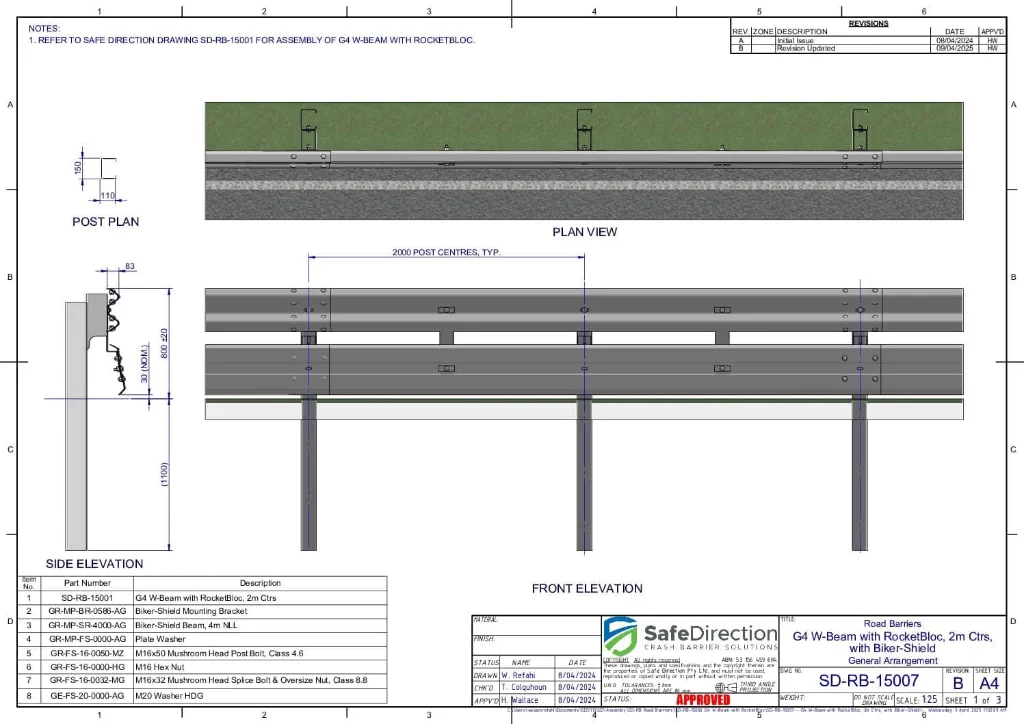
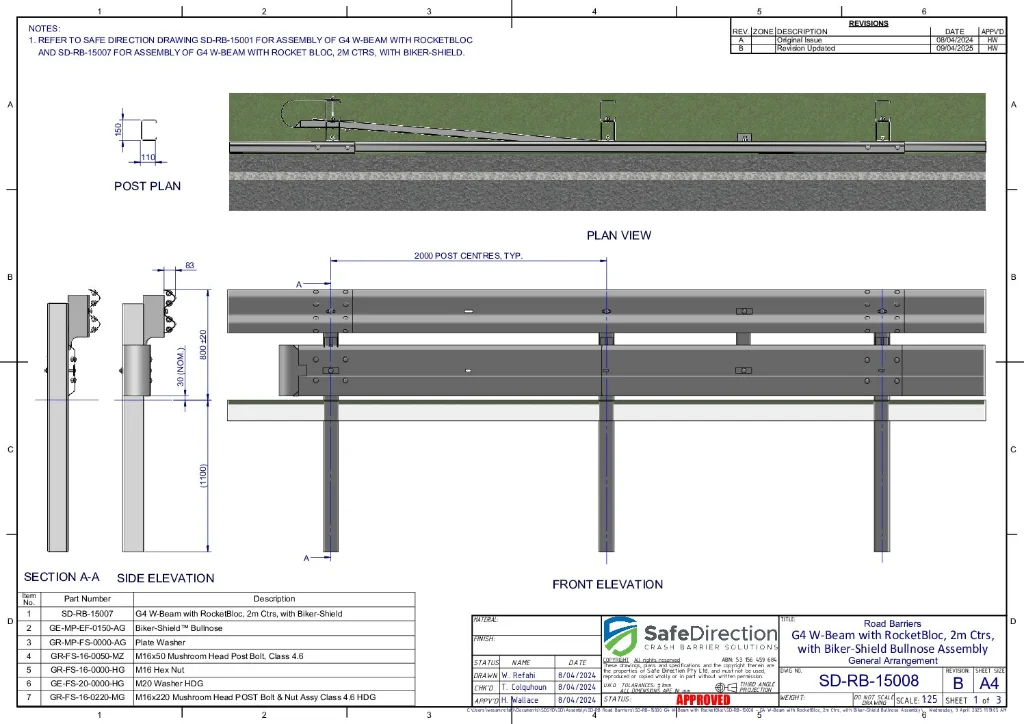
Yes. G4 W-Beam Guardrail systems retrofitted with RocketBloc® are compatible with BikerShield, designed to shield the supporting C-posts from a sliding, dismounted rider. The BikerShield panels are supported by spring brackets that are secured to the rear of the w-beam guardrails.
What is MASH?
The Manual for Assessing Safety Hardware (MASH) provides uniform guidelines for the crash test assessment of permanent and temporary road safety hardware.